Relational Database Management System
Concept of RDBMS
RDBMS stands for Relational Database Management System. All modern database management systems like SQL, MS SQL Server, IBM DB2, ORACLE, My-SQL, and Microsoft Access are based on RDBMS. It is called Relational Database Management System (RDBMS) because it is based on the relational model introduced by E.F. Codd.
How it works--
Data is represented in terms of tuples (rows) in RDBMS. A relational database is the most commonly used database. It contains several tables, and each table has its primary key. Due to a collection of an organized set of tables, data can be accessed easily in RDBMS.
Brief History of RDBMS:-
From 1970 to 1972, E.F. Codd published a paper to propose using a relational database model. RDBMS is originally based on E.F. Codd's relational model invention.
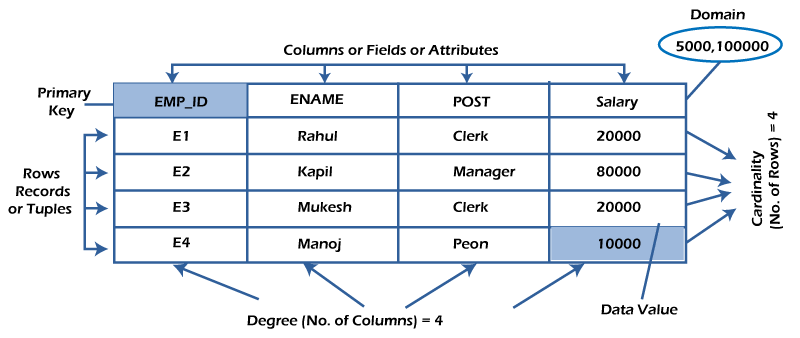
Following are the various terminologies of RDBMS:
What is table/Relation?
Everything in a relational database is stored in the form of relations. The RDBMS database uses tables to store data. A table is a collection of related data entries and contains rows and columns to store data. Each table represents some real-world objects such as person, place, or event about which information is collected. The organized collection of data into a relational table is known as the logical view of the database.